
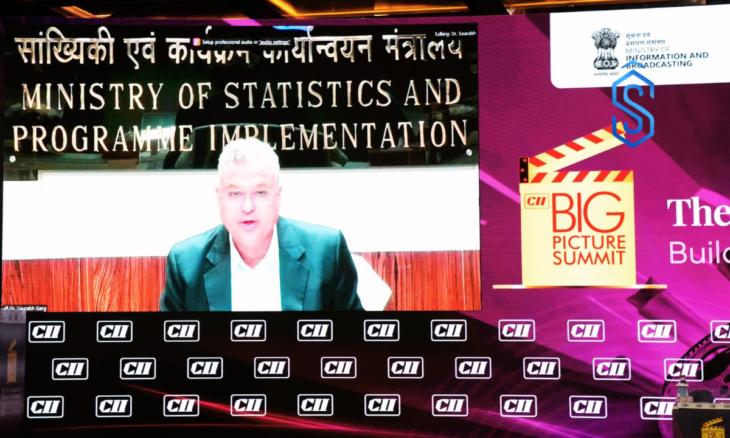
Mumbai: India’s creative economy will receive the policy support it deserves only when its contribution is properly measured, Dr. Saurabh Garg, Secretary, Ministry of Statistics and Programme Implementation, said at the CII Big Picture Summit.
Garg outlined how official statistics are being rebuilt to capture creators, platforms, intellectual property (IP) and other aspects of India’s growing creative economy.
Speaking virtually at the CII Big Picture Summit, Garg said Prime Minister Narendra Modi’s identification of soft power as the seventh pillar of the Viksit Bharat vision in his Independence Day address had made measuring creative activity a national priority.
“Creativity is fast emerging as a real source of economic value,” Garg said. “A robust measurement framework will tell us the scale and composition of creative work, where India has comparative strength and where potential remains untapped.”
Garg is the first statistics secretary to address a media and entertainment summit, bringing the ministry responsible for India’s GDP and employment data into a conversation traditionally led by studios and other industry stakeholders.
India’s Creative Economy and Media & Entertainment Sector
According to NITI Aayog, India’s creative economy is valued at $30 billion and employs nearly 8% of the workforce. Creative services exports reached $11 billion in 2024 and are growing at about 20% annually.
The media and entertainment sector was valued at around ₹2.5 trillion in 2024, with digital media accounting for one-third of revenue.
Gaming stood at around ₹232 billion, while animation and visual effects were valued at ₹103 billion. Live entertainment was above ₹100 billion.
The sector supports more than 10 million livelihoods, highlighting the scale of creative activity that the CII Big Picture Summit discussion sought to address through better measurement and official data.
Four Steps to Measure Creative Activity
At the CII Big Picture Summit, Garg outlined four steps being taken to improve the measurement of India’s creative economy.
The revised National Industrial Classification now includes influencers on digital and social media, video game publishing with in-app purchases, OTT streaming services and content-sharing platforms.
The new Index of Services Production, with a 2024-25 base year, provides monthly indicators for 19 service sub-sectors, including broadcasting and entertainment.
The Periodic Labour Force Survey also began collecting platform worker data in January 2026 on an experimental basis. This is intended to help capture employment generated through the growing platform economy.
The fourth initiative is the development of a framework to measure the knowledge economy, including traditional Indian knowledge systems.
These measures form part of the broader effort discussed at the CII Big Picture Summit to ensure that emerging forms of creative and knowledge-based economic activity are reflected in official statistics.
Focus on Intellectual Property Creation and Ownership
Garg identified intellectual property as the next frontier for measuring India’s creative economy. He said the opportunity is shifting from content production towards ownership of intellectual property.
“The opportunity is moving from content production to IP ownership,” Garg said. “If India is to shift from servicing global studios to licensing Indian IP, our statistics must track IP creation, ownership, licensing and exports.”
The comments at the CII Big Picture Summit highlighted the importance of tracking not only the production of creative content but also the ownership, licensing and export of intellectual property generated in India.
Budget Support for AVGC and Creator Skills
Garg also welcomed the support announced in Budget 2026-27 for AVGC creator labs in 15,000 schools and 500 colleges.
The initiative comes as the sector is expected to require nearly 2 million professionals by 2030. The focus on creator labs and professional talent was highlighted at the CII Big Picture Summit in the context of the growing demand for skilled professionals across animation, visual effects, gaming and comics.
The emphasis on better measurement, expanding statistical classifications, tracking platform workers and developing frameworks for intellectual property is aimed at building a clearer picture of India’s creative economy and its contribution to economic activity.
Also Read: Global Entertainment and Media Outlook 2026-2030: India’s E&M Market to Hit $36.7 Billion by 2030